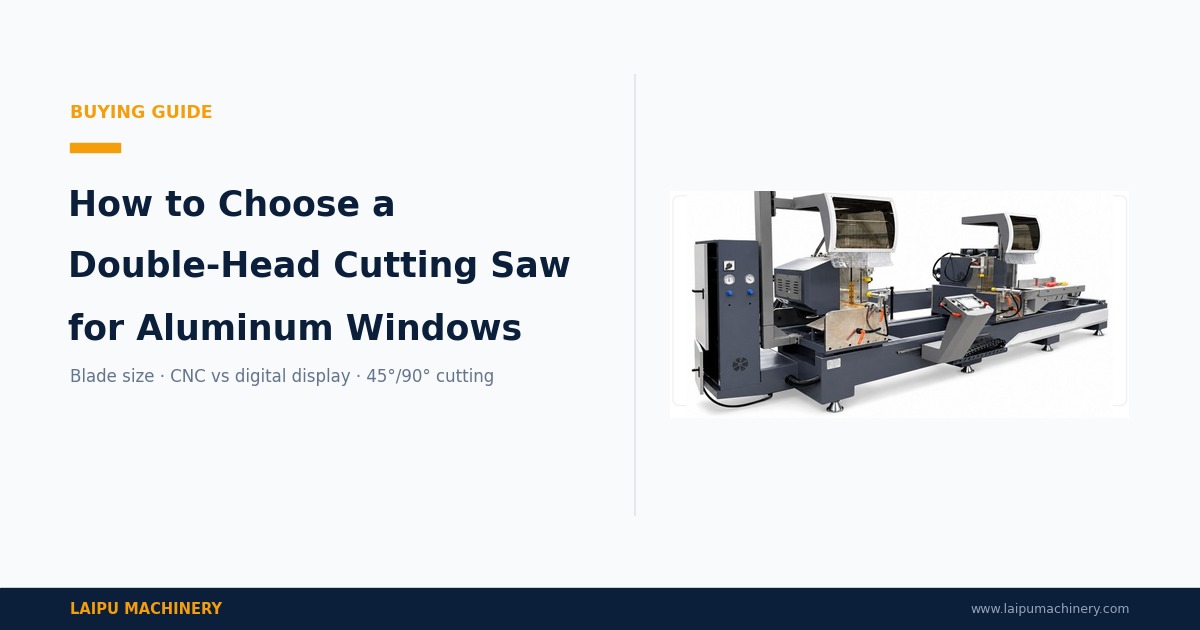
The double-head cutting saw is the first machine in every aluminum window production line, and it decides the accuracy of everything that follows. A frame cut one millimeter out of square becomes a window that leaks, jams, or cracks its glass under thermal stress. Yet most first-time buyers compare saws only by price and blade diameter. This guide explains the five decisions that actually determine whether a saw fits your production — based on the questions our engineers ask customers before recommending a configuration.
1. Cutting length: match the saw to your longest profile
The working length of the saw (commonly 3700, 4200, or 5000 mm) must cover the longest profile in your window system plus clamping margin. A 4200 mm saw covers most residential window systems comfortably; go to 5000 mm if you fabricate commercial curtain-wall or large sliding-door profiles. Do not buy extra length "just in case" — a longer bed costs more, takes more floor space, and slows positioning.
2. CNC positioning vs digital display: where repeatability matters
Both types cut accurately. The difference is repeatability and labor. A digital-display saw is operated by a person reading numbers and moving the head — fine for 20–30 windows a day. A CNC saw stores cutting lists, positions each length automatically, and processes a whole job list without re-measurement. If you run batches of identical windows, CNC pays for itself in months through scrap reduction and operator time.
- Digital display: lowest cost, flexible for mixed one-off jobs, operator-dependent accuracy.
- CNC with list processing: automatic length positioning, cut counting, label printing options — ideal for batch production above ~30 windows/day.
- CNC + profile-height measuring: adds automatic measurement of profile height for saw-path optimization — worth it for multi-profile workshops.
3. Blade size and what it says about the machine
A 500 mm carbide blade is the standard for window profiles and cuts typical mullion sections in one pass. A 550 mm blade adds capacity for deep curtain-wall or industrial profiles. More important than diameter is rigidity: cast monoblock heads damp vibration far better than fabricated weldments, which is why premium saws use one-piece cast heads. Vibration, not blade quality, is the usual cause of burr and angle deviation.
4. Angle switching: 45°/90° dedicated or combined?
Window frames need 45° miters; some transoms and special joints need 90°. Most double-head saws switch between 45° and 90° pneumatically. If you cut miter-only frame pieces at volume, a dedicated 45° single-purpose saw is faster and holds angle accuracy longer because it has no switching mechanism to wear. High-volume shops often run a dedicated 45° saw plus a combined machine for the rest.
5. Feeding, damping and safety details that matter daily
- Pneumatic-hydraulic damping gives a uniform blade feed — look for it on both heads.
- Automatic safety guards that open/close with the cycle save seconds on every cut and protect the operator.
- Lubrication on transmission parts (rack, linear guides) is standard on CNC models — check it on manual machines.
- Right-head movable with automatic feeding saves one operator on long jobs.
Quick reference
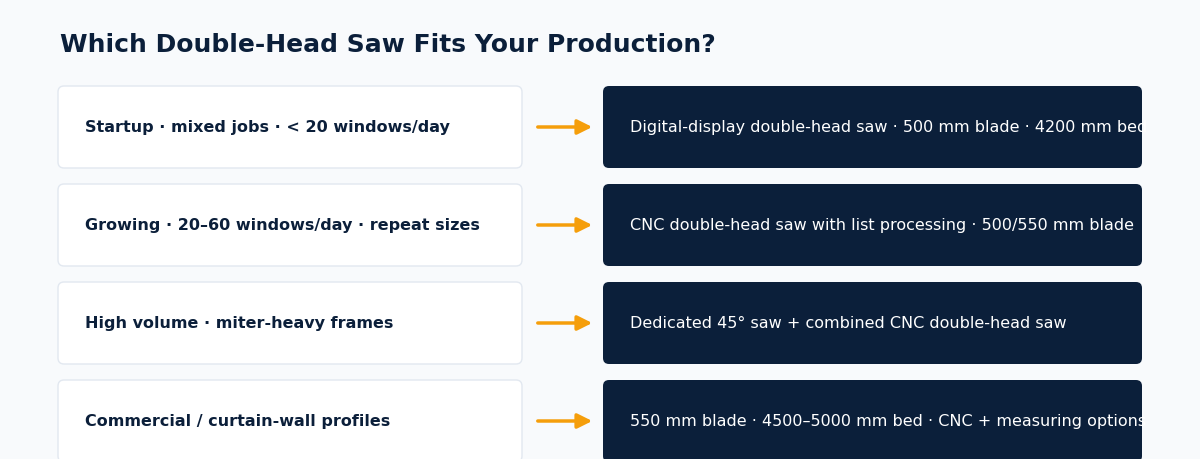
| Your situation | Recommended configuration |
|---|---|
| Startup, mixed jobs, < 20 windows/day | Digital-display double-head saw, 500 mm blade, 4200 mm bed |
| Growing shop, 20–60 windows/day, repeat sizes | CNC double-head saw with list processing, 500/550 mm blade |
| High volume, miter-heavy frames | Dedicated 45° precision saw + combined CNC double-head saw |
| Commercial/curtain-wall profiles | 550 mm blade, 4500–5000 mm bed, CNC with measuring options |
Double-head saws in the LAIPU range
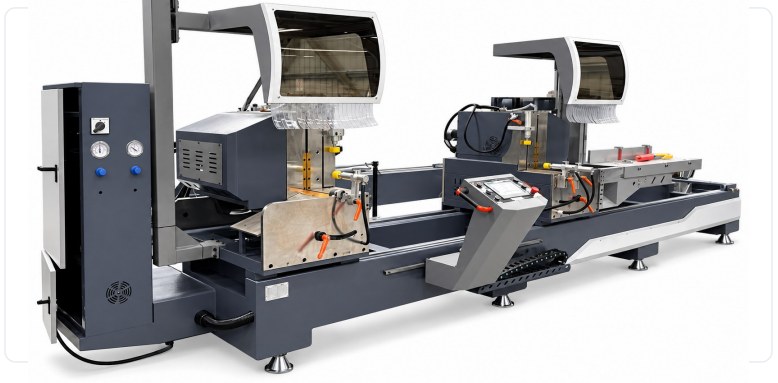
CNC Double-Head Precision Cutting Saw for Aluminum Profiles
LJZ2S-CNC-550×4200A
View machine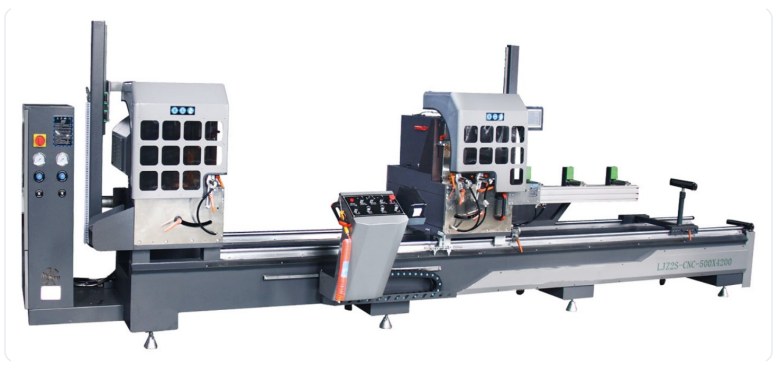
Double-Head Precision Cutting Saw for Aluminum Profiles
LJZ2S-500×4200A
View machine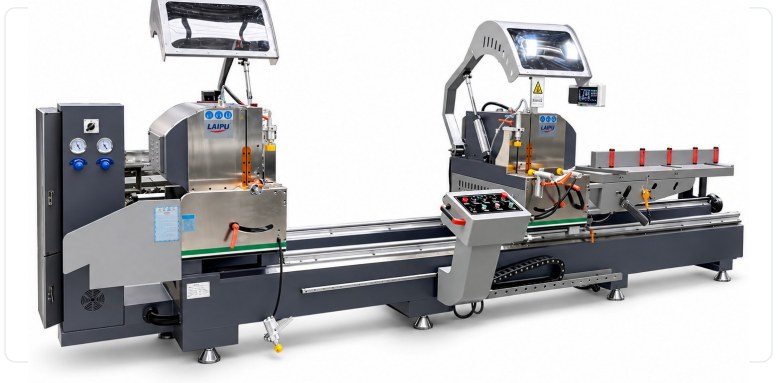
Digital-Display Double-Head Precision Cutting Saw
LKJZ2-500×4200
View machine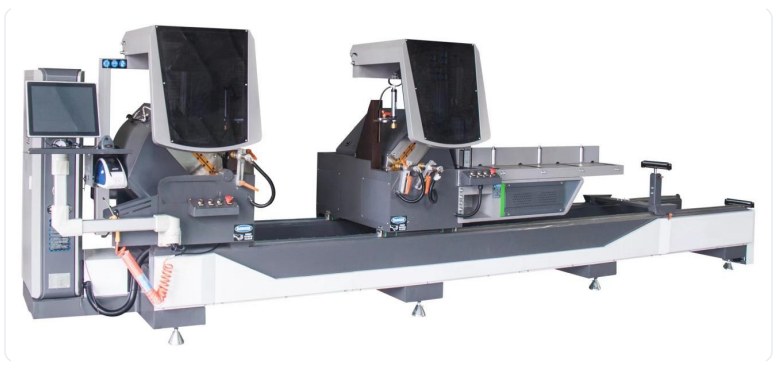
Cast Monoblock Precision Cutting Saw · Network / QR-Code Version
YT-CNC-500×4200 · 联网扫码版
View machine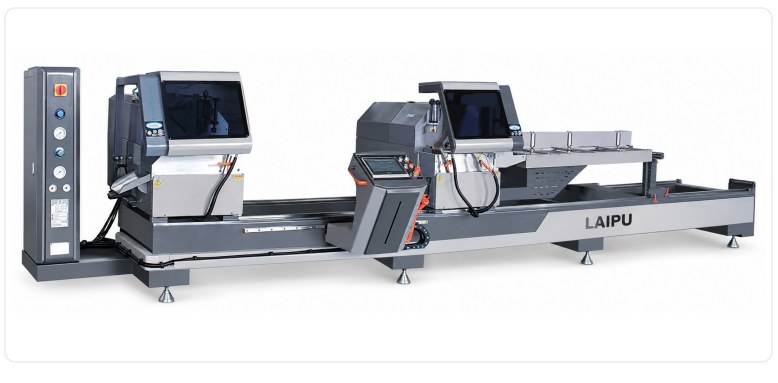
CNC 45° Dedicated Precision Saw · 10-inch Screen
WGD-CNC-550×4200A · 10寸屏版
View machineFrequently asked questions
What power supply do these saws need?
Most models run on 380 V / 50 Hz three-phase power, with 220 V options on some configurations. Confirm your local voltage and frequency before ordering — converters for 60 Hz regions are available.
Can one saw handle both aluminum and uPVC profiles?
Aluminum saws run much higher blade speeds and different blade geometry than uPVC saws. We recommend a dedicated machine per material; cutting uPVC on an aluminum saw causes melting and poor finish.
How accurate is a CNC double-head saw?
Typical positioning repeatability is ±0.1 mm on servo-driven CNC models, and cutting angle accuracy within ±0.1° when the machine is properly leveled and maintained.
What consumables should I budget for?
Carbide blades (lifespan depends on profile alloys and lubrication), replacement pneumatic seals, and saw coolant/lubricant if fitted. Blade cost is usually the largest recurring item.
Need a machine configuration for your factory?
Send your profile system and capacity target — reply within 24 hours on email or WhatsApp.